Intertek Verified Supplier Ningbo, Zhejiang, China info@cefnakauto.com
0%

China has become an important sourcing destination for motor-making equipment, but choosing a supplier takes more than comparing quoted prices. This guide to the Best Automatic Motor Production Line Manufacturers in China focuses on capabilities buyers can verify: engineering support, equipment integration, quality controls, and experience with the intended motor type. Details matter.

An Automatic Motor Production Line may combine coil winding, stator insertion, rotor assembly, balancing, and electrical testing. Some lines also include laser marking, automated handling, and production data collection. The right configuration depends on motor design, target output, available floor space, and how often products change. A fast cycle time means little if changeovers are difficult or test results cannot be traced to individual units.

When reviewing manufacturers, ask for process descriptions, sample test records, installation plans, and clear acceptance criteria. A factory visit or live equipment demonstration can help confirm how stations work together. Check what the quoted scope includes, from tooling and operator training to commissioning and after-sales service. Not every line fits. One limitation is that public information rarely reveals how a system performs across long production runs, so specific references and realistic trials are valuable. This overview is a starting point, not a universal ranking; the best choice depends on your technical requirements and the supplier’s ability to support them over time.
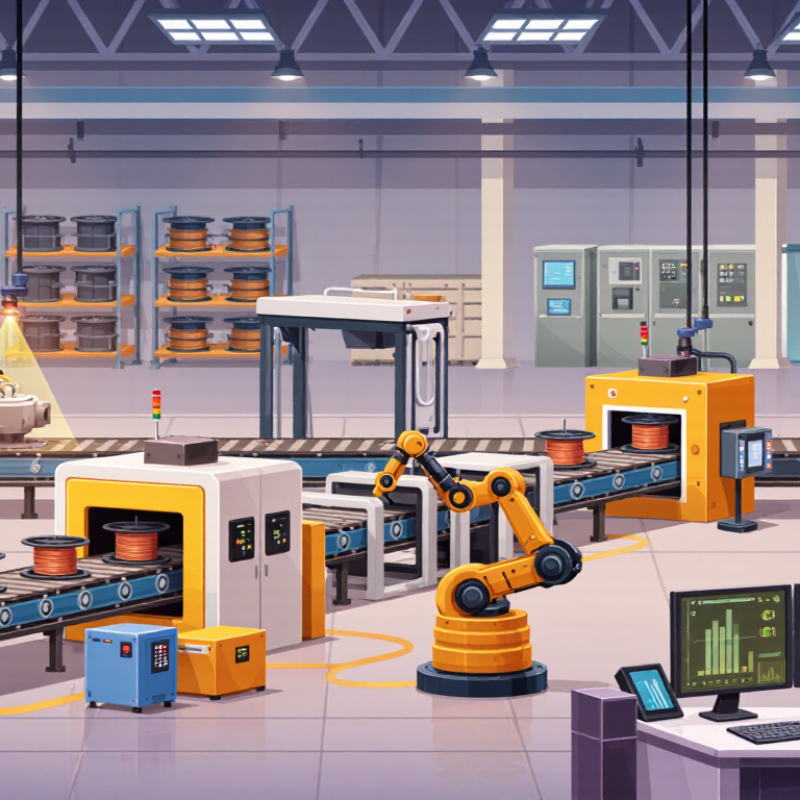
Best Automatic Motor Production Line Manufacturers in China

What Is an Automatic Motor Production Line?

An automatic motor production line is a coordinated set of machines, fixtures, and control systems that makes motor assembly more consistent. Depending on the motor design, it may handle stator winding, insulation checks, rotor assembly, shaft pressing, fastening, and final testing. Parts move between stations on conveyors or transfer units, while sensors check their position and presence. A programmable controller coordinates each step and can record basic production data.

At a winding station, for example, a nozzle guides copper wire into narrow slots in the stator core. Later stations may measure winding resistance, check insulation, and test vibration or noise after assembly. These checks help identify faults before motors leave the factory.

Still, automation does not guarantee perfect output. A poorly positioned fixture or worn tool can affect many units before anyone notices. Line design must match the motor’s size, output, and expected production volume; changing models may require new tooling and careful setup.

Not plug-and-play.

Operators still need clear inspection procedures, maintenance records, and training. A practical line balances cycle time with enough checks to catch defects without disrupting production.

Which Manufacturing Processes Can Be Automated?

Automatic motor production lines can handle many repeatable steps, from laminating and stacking stator cores to winding copper wire around each slot. Programmable winding machines control wire tension and coil placement, while insertion equipment seats coils without damaging insulation. Small deviations matter. A misplaced wire can cause extra resistance or fail a later test.

Automation can also support rotor assembly, shaft pressing, fastening, adhesive dispensing, and selected welding operations. Sensors check part position and process values as components move between stations. After assembly, balancing machines detect uneven rotation, and electrical testers measure insulation resistance, winding continuity, and operating characteristics. Results can be linked to each unit’s production record. That matters.

Not every task benefits equally from full automation. Changing motor designs may require flexible fixtures or operator adjustments, and delicate wiring can still need human inspection. A practical line combines automated stations with clear checkpoints, especially where vision systems may miss damaged insulation or unusual surface defects. Even a well-tuned machine needs routine calibration and maintenance. This is easy to overlook. Teams should validate each process using the actual motor design, production volume, and acceptable quality limits before expanding automation.

What Technologies Drive Modern Motor Production Lines?

Modern motor production lines rely on connected automation, not robots alone. Automated winding controls wire tension and coil placement, while servo presses fit shafts and bearings with repeatable force. Machine vision checks insulation, welds, and component alignment under consistent lighting. Small errors matter. A misplaced turn can affect a motor’s performance long after assembly.

The International Federation of Robotics’ World Robotics 2024 report recorded 541,302 industrial robots installed worldwide in 2023. China accounted for 276,288 installations. These figures describe industrial robotics broadly, not motor factories alone, but they show the scale of automation available to manufacturers. In a motor line, robots can handle repetitive loading, while inline sensors monitor temperature, vibration, and electrical resistance.

Digital tracking links each motor’s test results to its production history. Digital twins can help engineers compare line settings with real operating data, but their accuracy depends on good sensor inputs. The International Energy Agency reported nearly 14 million electric car sales in 2023, increasing pressure for flexible motor capacity. Yet automation is not a cure-all. Sensors can miss defects, and frequent product changes still require careful setup. Scrap still happens.

Best Automatic Motor Production Line Technologies

Example cycle times for key motor-manufacturing operations on an automated production line.

Illustrative planning values, not measured industry benchmarks. Actual cycle times depend on motor design, line layout, and production volume. Automation, precision winding, robotic assembly, dynamic balancing, and end-of-line testing help improve consistency and traceability.

How Do Chinese Manufacturers Differ in Their Capabilities?

Chinese automatic motor production line manufacturers differ less by their catalog size than by how well they connect process, controls, and validation. Some focus on stator winding, rotor assembly, or testing equipment. Others can integrate these stations into a coordinated line with material handling and traceability. The difference matters when a motor design changes: can the supplier adjust tooling, cycle times, and inspection points without rebuilding the whole system?

Look beyond the quoted output rate. Ask how the line handles wire tension, press-fit tolerances, insulation checks, and model changes. A capable engineering team should explain its assumptions and show sample test records, not just a polished layout. During a factory visit, watch a changeover and inspect how operators access fixtures and troubleshoot alarms. These details reveal practical design choices. Still, a strong proposal can hide gaps; I would not treat a demonstration as proof of long-term uptime.

Tips: Share drawings, target cycle time, and expected product variations before comparing quotes. Request a sample acceptance plan, spare-parts list, and clear responsibility boundaries. Small omissions can become expensive later.

What Factors Should Buyers Consider When Comparing Manufacturers?

When comparing automatic motor production line manufacturers in China, assess the process, not just the quoted output. Ask how winding, insulation, assembly, balancing, and end-of-line testing connect. A fast station means little if parts queue between machines. Request cycle-time data for your motor model, plus changeover time and demonstrated yield. Check whether test records include serial numbers, measurements, and timestamps.

The International Federation of Robotics’ World Robotics 2024 report recorded 541,302 industrial robot installations worldwide in 2023. This shows the scale of automation, but it does not prove a particular line will meet your requirements. Ask manufacturers for factory acceptance test results using comparable products. Confirm what happens when a test fails, a sensor drifts, or production stops. These details are easy to overlook. I would also compare spare-parts lead times and local service coverage, not only warranty length.

Tips: Request a sample traceability report and a short video of a full production cycle. Put acceptance criteria, training, and response times in writing. A low price can still be attractive, but check what equipment or support it excludes. After-sales capacity deserves a second look.

Best Automatic Motor Production Line Manufacturers in China - What Factors Should Buyers Consider When Comparing Manufacturers?

Comparison Factor What Buyers Should Compare Useful Evidence to Request Buyer Evaluation Check
Process Coverage Whether the proposed line covers the required operations, such as component loading, winding, assembly, connection, testing, and unloading. Process flow diagram, equipment list, line layout, and a clear list of operations included or excluded from the quotation. Confirm that every required product variant and production step is accounted for, including manual workstations where applicable.
Production Capacity Quoted cycle time, planned operating hours, changeover time, and the capacity of the slowest process in the line. Cycle-time study by station, bottleneck analysis, stated operating assumptions, and a sample production schedule. Compare capacity using the same product, shift pattern, staffing assumptions, and uptime definition. Do not compare cycle time alone with finished-output targets.
Product Quality Control How critical characteristics are controlled during production, such as winding parameters, assembly dimensions, electrical connections, and test results. Inspection and test plan, measurement-device list, sample test reports, and procedures for handling nonconforming parts. Check that test limits and acceptance criteria match the buyer’s drawings and product specifications, and that failed units can be identified and contained.
Process Capability Whether the supplier can demonstrate stable output for critical, measurable process characteristics. Capability study or trial data for agreed characteristics, with sample size, measurement method, and operating conditions stated. Review the data and acceptance thresholds with the buyer’s quality team; capability indices are meaningful only when the process and measurement system are suitable.
Product Flexibility Supported motor types, size ranges, tooling requirements, recipe management, and the time and effort needed to change models. Product compatibility matrix, changeover procedure, tooling list, and a witnessed changeover demonstration where practical. Verify flexibility against the actual product family and forecast mix rather than relying on a general claim of “multi-model” capability.
Controls and Traceability Control-system architecture, operator interface, data collection, fault history, and the ability to associate test or process records with each unit or batch. Controls specification, sample production records, data fields, backup and restore procedure, and interface details for any required factory systems. Agree on which data must be recorded, how long it must be retained, and how it will be exported or integrated before finalizing the specification.
Machine Safety Risk assessment, guarding, interlocks, emergency stops, and electrical safety provisions for the intended installation and market. Machine risk-assessment documentation, safety-device list, electrical drawings, and applicable conformity documentation. Confirm applicable local regulations and standards for the destination market. ISO 12100 and IEC 60204-1 are commonly referenced standards, but applicability should be verified for each project.
Factory Acceptance Testing How the completed line will be tested before shipment, including operation, output, product quality, alarms, and changeovers. Agreed factory acceptance test (FAT) protocol, sample products, pass/fail criteria, and a record of test results and open issues. Define the FAT conditions in the contract, including who supplies samples, what performance is measured, and how unresolved issues are closed.
Installation and Commissioning On-site installation scope, commissioning support, operator training, and responsibilities for utilities, foundations, and production materials. Installation schedule, site-readiness checklist, commissioning plan, training agenda, and a written list of buyer and supplier responsibilities. Check that the schedule includes site preparation and that acceptance criteria distinguish installation completion from production performance approval.
Service and Spare Parts Remote and on-site support arrangements, response process, spare-parts availability, and maintenance requirements. Service terms, recommended spare-parts list, maintenance schedule, troubleshooting documentation, and support contact procedure. Identify critical wear parts and long-lead components, then confirm expected delivery arrangements and support coverage for the installation location.
Utilities and Facility Needs Electrical supply, compressed air, extraction, floor space, access, and any environmental conditions required by the equipment. Utility-consumption list, layout with service clearances, connection specifications, and facility requirements. Compare the stated requirements with the actual factory site and include installation access, maintenance clearance, and material flow in the review.
Project Scope and Commercial Terms Equipment included, exclusions, documentation, packaging, delivery, installation, training, warranty, and payment milestones. Itemized quotation, scope-of-supply statement, project schedule, warranty terms, and a written list of assumptions and exclusions. Normalize quotations to the same scope and acceptance conditions before comparing total cost; separately identify options and recurring costs.

Comparison note: Use a common technical specification and scoring method for all quotations. Confirm performance claims through agreed tests and documented acceptance criteria rather than relying on headline figures alone.

FAQS

Which motor production tasks can be automated?

Lines can laminate and stack stator cores, wind copper wire, insert coils, and assemble rotors. They can also press shafts, fasten parts, dispense adhesive, and perform selected welding operations.

How do automated winding machines protect copper wire?

Programmable machines control wire tension and coil placement. Insertion equipment seats coils while protecting insulation. Small errors still matter.

What tests can an automated line perform?

Balancing machines check for uneven rotation. Electrical testers measure insulation resistance, winding continuity, and operating characteristics. Results can be linked to each motor’s production record.

Does every production task benefit from full automation?

No. Changing designs may need flexible fixtures or operator adjustments. Delicate wiring and unusual surface defects can still require human inspection. Machines miss things.

What should buyers check beyond a line’s quoted output rate?

Ask how it handles wire tension, press-fit tolerances, insulation checks, and model changes. A high output figure alone says little about everyday reliability.

How can a manufacturer’s engineering capability be assessed?

Ask for sample test records and explanations of key assumptions. Watch a changeover during a factory visit, and see whether operators can reach fixtures and troubleshoot alarms.

What information should be shared before comparing proposals?

Provide drawings, target cycle time, and expected product variations. Request an acceptance plan, spare-parts list, and clear responsibility boundaries. Small omissions can cost later.

What should be validated before expanding automation?

Test processes using the actual motor design, production volume, and quality limits. Check calibration and maintenance needs, too. A polished demonstration is not proof of long-term uptime.

Conclusion

An Automatic Motor Production Line integrates machinery, control systems, and quality checks to manufacture motors with greater consistency and efficiency. Depending on the product and factory requirements, automation can cover component feeding, stamping, winding, assembly, welding, balancing, testing, and packaging. Modern lines may use robotics, machine vision, sensors, data tracking, and programmable controls to coordinate operations, identify defects, and support stable production.

Chinese manufacturers can differ in their engineering expertise, equipment range, customization options, and ability to integrate a complete line with existing factory systems. Buyers comparing suppliers should consider the motors to be produced, required output and quality standards, available floor space, flexibility for future product changes, installation and training support, maintenance needs, and total ownership costs. A careful comparison of these factors helps identify a solution that fits both current production goals and long-term plans.

Clara

Clara

Clara is a professional marketing specialist with a strong understanding of the company’s products, their practical applications, and the needs of the people who use them. She regularly contributes expert articles to the company website, turning product knowledge and industry insights into clear,......