Recommended Motor Manufacturing & Winding Equipment
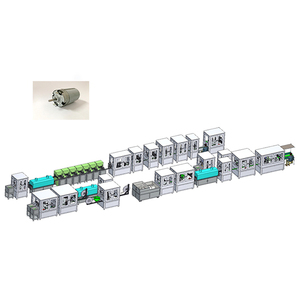
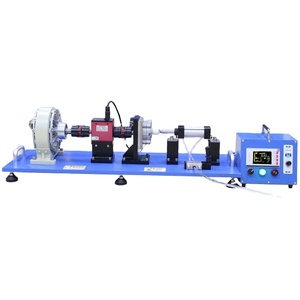
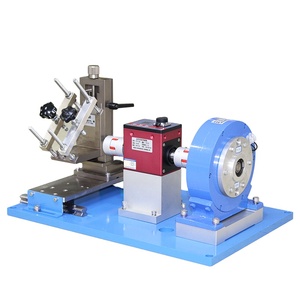
Explore precision flyer winding machines, automated assembly lines, and end-of-line testing equipment engineered for global OEMs.
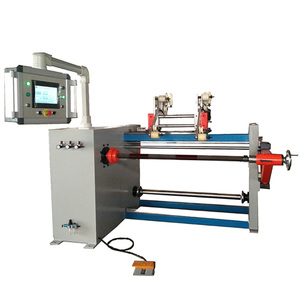

Understanding Modern Flyer Winding Machine Architecture & Engineering Principles
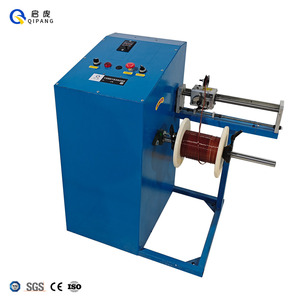
In high-efficiency electric motor manufacturing, the selection of coil winding technology directly dictates operational efficiency, thermal resistance, slot fill factor, and electromagnetic performance. A flyer winding machine (also referred to as a flying arm winder or rotating flyer coil winding system) is a specialized automated motion apparatus engineered to wind copper wire onto stationary armatures, external stators, bobbins, or multi-pole cores. Unlike conventional spindle winders where the bobbin rotates, flyer winding technology utilizes a rapidly spinning mechanical arm (flyer) to orbit around a stationary winding mandrel or fixed core.
This structural arrangement eliminates the rotational inertia of heavy stators or bulky transformer bobbins, enabling ultra-high RPM winding velocities while preserving strict wire placement geometry. Modern flyer winding equipment manufactured by premier Chinese automation specialists integrates multi-axis CNC servo synchronization, dynamic closed-loop tension regulation, and micro-programmable wire guide nozzles. This results in consistent layer distribution, minimal copper wire enamel abrasion, and superior electrical balance.
Kinematics & Servo Dynamics of Flying Arm Technology
The core mechanical kinematic chain of an industrial flyer winder relies on synchronized dual-axis or quad-axis servo motion control. The main flyer arm spindle handles high-speed orbital rotation while a secondary linear CNC axis manages vertical or axial traverse pitch, precisely positioning the wire into narrow stator slots or bobbin grooves. Advanced flyer winders designed for BLDC motor stators and universal armatures utilize real-time electronic camming (e-CAM) algorithms to compensate for centrifugal wire bowing forces at extreme velocity transitions.
Closed-Loop Tensioning
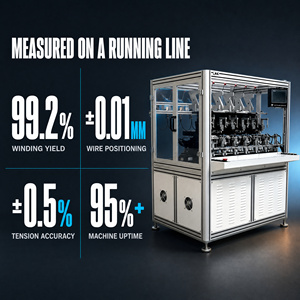
Active electromagnetic hysteresis brakes combined with real-time load cell feedback dynamically adjust wire payoff tension to guarantee zero micro-deformation on fine copper wire gauges.
High Slot Fill Factors
Precision CNC wire guides and servo-driven indexing heads allow dense, uniform orthocyclic coil layering, pushing stator slot fill factors up to 75%–82% for maximum motor torque density.
Tooling Quick-Change System
Modularity engineered into clamping fixtures and wire guide arms reduces changeover times to under 15 minutes for multi-variant brushless DC motor production runs.
Global Procurement & Sourcing Trends in Electric Motor Manufacturing (2025–2030)
As the global industrial landscape transitions toward industrial electrification, high-efficiency premium energy standards (IE4 and IE5), and rapid growth in electric mobility (EVs), the procurement criteria for motor manufacturing equipment have undergone a fundamental shift. Sourcing managers and production line engineers are moving away from stand-alone, manual coil winders in favor of fully integrated, smart automated winding cells provided by leading OEM manufacturers in China.
1. Integration of Turnkey Industrial Internet of Things (IIoT) & MES
Modern international procurement contracts now mandate comprehensive data connectivity. High-speed flyer winding machines from qualified Chinese wholesalers are equipped with OPC-UA communication protocol interfaces, IO-Link sensors, and integrated Manufacturing Execution System (MES) software compatibility. Procurement managers can monitor real-time key performance metrics including overall equipment effectiveness (OEE), cycle takt times, wire consumption metrics, tension log telemetry, and predictive maintenance diagnostics remotely.
2. Transition Towards Multi-Wire Parallel Winding & Heavy-Gauge Formed Wire
Driven by demand from electric vehicle (EV) thermal management compressors, drone UAV propulsion units, and heavy-duty electric forklift traction motors, flyer winding machinery must now execute multi-wire parallel winding (simultaneously winding 2 to 6 strands of enamelled wire). This reduces skin-effect electrical losses at high operating frequencies while maximizing current carrying capabilities without compromising winding slot geometry.
3. Shift to Sample-Driven Customization & Virtual Process Simulation
Global OEMs no longer purchase off-the-shelf catalog machinery blindly. Winning Chinese export manufacturers stand out by offering end-to-end sample testing, 3D SolidWorks tooling simulations, FEA mechanical stress analysis on wire guides, and preliminary sample winding trials before contract finalization. This mitigates project implementation risk for overseas buyers.
Flyer Winding Technology Roadmap: Key Innovations Shaping Next-Gen Motor Automation
Understanding the technological trajectory of coil winding machinery allows procurement directors to future-proof their capital expenditure investment. The following key technological innovations define China's premium flyer winding manufacturing sector:
| Technology Domain | Legacy Winding Systems | Next-Gen Chinese Servo Flyer Winders | Impact on Motor Efficiency |
|---|---|---|---|
| Tension Management | Mechanical felt pad friction or passive spring tensioners | Active Closed-Loop Servo & Magnetic Hysteresis Brakes | Eliminates wire stretching, maintaining precise phase resistance balance. |
| Motion Controller | Single-axis pulse control PLCs | Multi-Axis EtherCAT / SERCOS EtherNet Motion Controllers | Smooth acceleration profiles; zero vibration at 5,000+ RPM flyer rotational speeds. |
| Tooling Flexibility | Fixed single-purpose dedicated fixtures | Modular 3D-Printed & CNC Machined Quick-Change Jigs | Reduces setup downtime between different stator stack heights by up to 70%. |
| Quality Assurance | Manual offline visual sampling after production | Inline Vision AI Inspection & High-Voltage Surge Testers | 100% real-time verification of wire overlapping, lead routing, and insulation layer. |
Hairpin Winding vs. High-Speed Servo Flyer Winding: Choosing the Right Process
While Hairpin (flat wire) winding technology has gained traction in main EV automotive traction motors, high-speed flyer winding remains the undisputed industry standard for fractional horsepower (FHP) motors, BLDC inner/outer stators, automotive auxiliary pumps, power tools, HVAC fan motors, drone UAV propulsion systems, and industrial solenoid coils. Flyer winders provide unmatched cycle flexibility, lower initial capital tooling cost, higher production line speeds, and seamless handling of round enamelled copper wire across diameters from 0.08mm to 1.8mm.
Enterprise Strength: Ningbo Davri Automation Equipment Co., Ltd. (Cefnak)
As an independently verified supplier audited on-site by Intertek, Ningbo Davri Automation Equipment Co., Ltd. (Cefnak) represents the pinnacle of Chinese automated motor manufacturing engineering. Operating from Ningbo, Zhejiang—one of the world's premier industrial automation clusters—we specialize in designing and manufacturing high-precision needle-type internal stator winders, outer stator flyer winders, armature rotor winders, and complete turnkey BLDC motor production lines.
Our unique competitive advantage lies in our dual-perspective engineering expertise: because we manufacture both high-end automated machinery and precision motor components (including UAV stators and permanent magnet synchronous motors), our automation engineers deeply understand how mechanical tension, stack lamination tolerances, and wire routing directly affect overall motor thermal performance and torque efficiency.
Frequently Asked Questions (FAQ) for B2B Procurement & Machinery Sourcing
Address critical engineering, logistical, and commercial inquiries when sourcing flyer winding machines and automated production lines from China.
1. What structural motor types can your flyer winding machines handle?
2. How does sample-based custom machine engineering work for international buyers?
3. How do you prevent enamel copper wire damage during high-speed flyer winding?
4. What after-sales installation, training, and technical commissioning support do you offer overseas?
5. What essential technical parameters are required to generate an accurate quotation?
6. What is the standard minimum order quantity (MOQ) and production lead time?
Partner with China's Leading Flyer Winding Machine Factory
Transform your electric motor manufacturing with precision-engineered flyer winders, automated assembly lines, and expert OEM customization backed by 11+ years of proven automation excellence.