Featured Motor Coil Production Lines & Winding Systems
Engineered to high precision standards with verified PLC/Servo controls for seamless copper and aluminum wire coil automation.
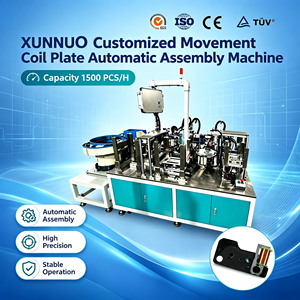
XUNNUO High Speed Movement Coil Assembly Machine
1000W Servo Motor drive system integrated with advanced PLC engine for high-speed automated production with a 1-Year comprehensive warranty.
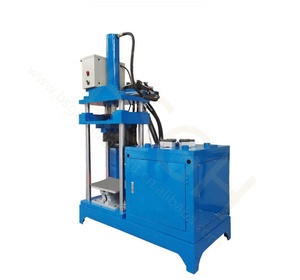
Stator Coil Winding Final Forming Machine
Dual copper and aluminum wire processing line engineered for precision geometric shaping and coil end-dimension stabilization.
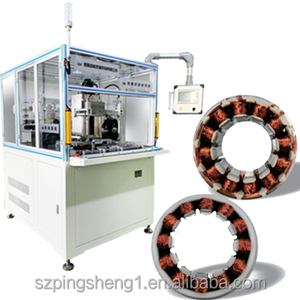
Large Motor Stator Coil Winding Production Line
Heavy-duty stator coil winding platform optimized for high-torque industrial motors, high-gauge copper wire, and multi-slot geometries.
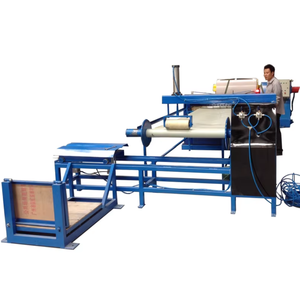
0.2~0.8mm Baby Coil Recoiling Production Line
Precision 1250mm tension-controlled recoiling machine line designed with motor core components for micro-wire and baby coil operations.
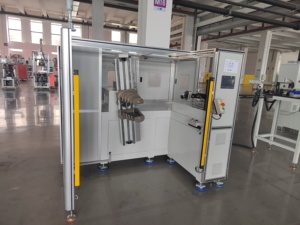
Customized CNC Brushless Motor Automation Line
High-accuracy automatic multi-specification coil winding machinery designed for BLDC internal stators and custom multi-pole motors.
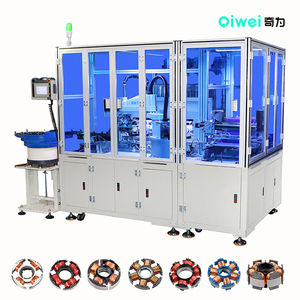
Qiwei Full Automatic CNC Winding Production Line
Fully automated winding machine specifically tailored for cooling fan motors, gear components, and high-efficiency small appliance stators.
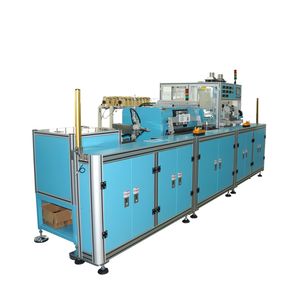
Fully Automatic Relay & Transformer Coil Winding Line
Versatile production line handling solenoid coils, relays, contactors, transformers, inductors, buzzers, and specialized speaker components.
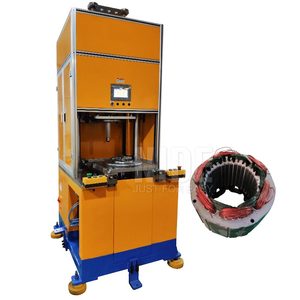
AC/DC Motor Stator Winding Middle Forming Line
Intermediate shaping machine for AC/DC induction motors, ensuring optimum slot fill ratio and insulation space before final expansion.
Industry Analysis: The Electrification Driven Evolution of Motor Coil Production
Whitepaper Depth Guidance on Modern Stator Winding, Needle-Type Automation, and High Slot-Fill Engineering
The global transition toward high-efficiency electric powertrains, smart industrial automation, and green HVAC systems has shifted the requirements for motor manufacturing equipment. Today’s international buyers and Original Equipment Manufacturers (OEMs) demand significantly more than standalone winding tools—they require turnkey, modular, and fully automated motor coil production lines capable of delivering consistent electromagnetic performance, minimal partial discharge, and ultra-high copper slot-fill ratios.
As China’s leading exporter and wholesaler of custom motor manufacturing equipment, Ningbo Davri Automation Equipment Co., Ltd. (operating globally under the engineering brand Cefnak) bridges the gap between sophisticated mechanical engineering and digitalized manufacturing controls. Operating from Ningbo, Zhejiang—the global nerve center for precision electrical equipment—our facility designs turnkey solutions spanning needle-type internal winding, outer-stator winding, armature coil forming, CNC commutator hot staking, and end-of-line (EOL) electrical quality assurance.
Information Gain Key Insight: Electromagnetic Efficiency vs. Slot Fill Factor
Traditional concentric winding techniques typically achieve a slot fill factor of 40% to 48%. Modern CNC servo-driven needle winding lines optimized by Cefnak elevate slot fill factors to over 62%. This directly reduces thermal resistance, minimizes stator copper losses ($I^2R$), and increases power density by up to 22% without expanding the motor's physical frame size.
Electromagnetic optimization relies fundamentally on the mechanical consistency of the coil line. Fluctuations in tension during high-speed wire placement induce micro-stretches in the enamel insulation layer, creating latent dielectric breakdown risks. Our production lines integrate active closed-loop electronic tension feedback systems that maintain wire tension tolerances within $\pm 0.5\text{ N}$, even during high-velocity directional changes exceeding 3,000 RPM.
Core Technical Architecture of Advanced Coil Production Lines
Integrated Engineering Components Supporting Maximum Up-Time and Zero-Defect Manufacturing
Multi-Axis Servo Synchronization
Utilizes multi-axis motion controller architecture (Beckhoff/Mitsubishi PLC) to synchronize flyer rotation, needle displacement, and index table positioning down to sub-millisecond cycles.
Closed-Loop Electronic Tensioners
Dynamic tension compensation prevents enamel flaking and micro-cracking across copper wire gauges ranging from 0.08mm to heavy 2.5mm magnet wires.
Automated Interslot Insulation
Integrated paper insertion and wedge-locking modules automatically cut, shape, and insert DMD, NMN, or Nomex insulation barriers before wire placement.
Middle & Final Shaping Tooling
Hydraulic and pneumatic expansion dies format the winding heads to exact spatial boundaries, eliminating coil overhang interference with motor end bells.
Technical Specification Matrix: Winding Methodologies Comparison
Selecting the Right Production Architecture Based on Motor Topology and Application Requirements
| Winding Technology | Target Stator / Rotor Topology | Optimal Wire Range | Slot Fill Factor | Typical Industrial Application |
|---|---|---|---|---|
| Needle Type Internal Winding | Inner-slot BLDC / PMSM Stators | 0.15 mm – 1.6 mm | 55% – 68% | EV Air Compressors, Power Tools, Automotive Pumps |
| Flyer Outer Stator Winding | External Rotor / Outrunner Stators | 0.20 mm – 1.2 mm | 50% – 62% | UAV Drone Motors, FPV Quadcopters, Ceiling Fans |
| Armature & Rotor Coil Winding | Slotted Commutator Armatures | 0.10 mm – 1.0 mm | 45% – 58% | Universal Brushed Motors, Vacuum Cleaners, Automotive Starters |
| Continuous Chain Production Line | Multi-station AC/DC Induction Stators | 0.25 mm – 2.2 mm | 60% – 72% | Industrial Pumps, HVAC Compressors, Logistics Forklifts |
Future Sourcing & Technology Trends (2025–2035)
Strategic Insights for Global Procurement Directors & Manufacturing Engineers
1. The Transition from Round Wire Winding to Flat Wire Hairpin Technology
In high-voltage automotive propulsion and heavy industrial mobility, traditional round magnet wire is rapidly giving way to rectangular "hairpin" flat wire configurations. Hairpin lines maximize thermal conductivity and elevate slot fill factors beyond 75%. Chinese equipment exporters are leading this shift by delivering affordable, high-precision hairpin pre-forming, twist-bending, and laser welding lines that cut CAPEX by up to 40% compared to legacy European equivalents.
2. AI-Driven In-Line Vision Inspection & Quality Closed-Loops
Quality assurance is transitioning from post-production batch testing to real-time optical verification. Modern lines exported by Cefnak incorporate multi-camera AI machine vision modules at the winding point. These systems analyze coil geometry, detect crossover overlaps, and flag insulation displacement in real time before the stator moves to varnish impregnation—reducing scrap rates down to less than 0.02%.
3. Flexible Modular Lines for Rapid Motor Variant Changeover
Shorter product lifecycles demand extreme equipment versatility. Sourcing trends favor modular production cells where tooling dies, wire guide nozzles, and indexing clamps can be exchanged in under 15 minutes using quick-change pneumatic locks and pre-saved PLC recipe configurations. This allows factories to manufacture drone stators, power tool motors, and automotive pumps on the same core line.
Information Gain: Carbon Footprint & Energy Optimization in Varnish Curing
Traditional thermal oven curing consumes over 35% of a motor production facility’s electrical footprint. Future-ready coil lines utilize induction heating and UV resin trickling technology, curing insulating varnish in seconds rather than hours while shrinking line energy consumption by over 60%.
Enterprise Strengths & E-E-A-T (Experience, Expertise, Authoritativeness, Trust)
Why Global OEM Brands Trust Ningbo Davri Automation Equipment Co., Ltd. for Turnkey Engineering
Intertek On-Site Verified Manufacturer
Our manufacturing plant, engineering workshop, legal registration, and trade histories are independently audited and verified on-site by Intertek Group plc.
Sample-Based Tooling Customization
Send us your physical stator/rotor sample or CAD drawing (.STEP/.DWG). Our 5+ senior engineers design custom winding nozzles, fixtures, and software recipes tuned specifically to your parts.
Global On-Site Deployment & Service
We deploy qualified field application engineers directly to international customer plants for machine setup, line integration, operator training, and process optimization.
Rigorously Managed QA Laboratory
Equipped with 6 in-house testing instruments including digital tension meters, withstand voltage (hi-pot) testers, multi-channel temperature loggers, and video microscopes.
Frequently Asked Questions (FAQ) for Global Buyers
Detailed Technical Answers Addressing Sourcing, Machine Sizing, Tooling, and Commissioning
Which motor types can your custom coil winding production lines handle?
Our machinery covers four primary motor categories: 1) Inner-rotor BLDC & PMSM motors using needle-type internal winders; 2) External-rotor drone and treadmill motors using outer-stator winders; 3) Universal brushed AC/DC motors using rotor armature winders with hot staking integration; and 4) Large industrial AC induction motors using continuous chain coil winding and insertion lines.
What key parameters are required to generate an accurate technical proposal?
To size your line correctly on the first revision, our engineering team requires: 1) Stator/rotor 2D or 3D drawings indicating stack height, slot dimensions, and outer/inner diameters; 2) Wire gauge (mm or AWG) and enamel insulation rating; 3) Slot fill recipe (number of turns per slot, connection diagram); and 4) Target output (Units Per Hour / UPH or daily shift capacity).
How do your machines protect magnet wire insulation against damage during high-speed winding?
We utilize polished tungsten carbide wire nozzles, ceramic wire guides, and electronic closed-loop tensioners. Dynamic tension control keeps force within narrow parameters during needle acceleration and deceleration, preventing enamel micro-cracks, insulation stretch, and dielectric breakdown under hi-pot testing.
Can your lines process both copper and aluminum magnet wires seamlessly?
Yes. Aluminum wire requires specific tension adjustments and modified termination tooling due to its lower tensile strength and higher ductility compared to copper. Our machines feature pre-programmed PLC profiles for swift switching between copper and aluminum wire recipes.
What is the typical Minimum Order Quantity (MOQ) and production lead time?
For custom winding machines and complete assembly production lines, the MOQ is 1 set. For custom motor components such as UAV stators, the MOQ starts from 500 pieces. Manufacturing lead time for standard winding machines is typically 30–45 days, while complex turnkey lines range from 60 to 90 days depending on tooling complexity.
How is factory acceptance testing (FAT) conducted for international clients?
Prior to dispatch, we perform rigorous FAT trials in our Ningbo facility using your actual production samples and wire. Overseas clients can join live high-definition video acceptance sessions or visit our plant in person to inspect cycle times, slot fill aesthetics, and electrical insulation tests.
What after-sales service and technical support do you provide overseas?
We provide full remote technical support via video call, technical documentation, and PLC remote diagnostics. Additionally, our field service engineers travel internationally to install machines, train local operators, perform fine-tuning, and assist with initial mass production startup.
Are spare parts easily obtainable in overseas markets?
Yes. All core electrical and pneumatic components are sourced from globally recognized brands (such as Mitsubishi, Schneider, SMC, AirTAC, and Omron). Proprietary mechanical parts (such as winding needles and custom forming dies) are shipped with initial spare kits or can be re-ordered for rapid air-express delivery.
How does Cefnak ensure quality control across all manufacturing steps?
Every line undergoes an 8-stage QA protocol: raw material stamping inspection, stator stacking dimensional validation, winding tension testing, varnish insulation testing, dynamic balancing, electrical safety checks (hi-pot, surge, resistance), 24-hour continuous burn-in aging, and export packaging verification.
Can your production line integrate with existing ERP / MES factory systems?
Yes. Our PLC control cabinets support industrial Ethernet communication protocols (Modbus TCP/IP, Profinet, EtherCAT). Production data, cycle times, yield rates, and maintenance alerts can be exported seamlessly into your plant’s MES or Industry 4.0 ERP system.
Ready to Elevate Your Motor Manufacturing Efficiency?
Collaborate directly with Ningbo Davri / Cefnak engineering specialists. Send us your motor drawings or physical samples for a complimentary technical proposal and tooling evaluation.