Industry Intelligence Whitepaper
Global Market Shift: Navigating Electric Motor Assembly Sourcing in China
The global electric motor manufacturing sector is experiencing an unprecedented structural transformation. Driven by stringent international energy efficiency mandates (such as IE4 and IE5 standards), the hyper-expansion of commercial drone networks (UAV/FPV platforms), electric mobility (EVs, e-bikes, forklifts), and smart home automation, high-performance Brushless DC (BLDC) and Permanent Magnet Synchronous Motors (PMSM) have supplanted legacy brushed architectures. Consequently, procurement directors, plant engineers, and operational managers worldwide face a critical mandate: modernizing production assembly lines to achieve higher slot-fill ratios, sub-micron concentricity, flawless coil tension, and automated end-of-line (EOL) electrical validation.
China has solidified its position as the global epicenter for advanced electric motor production machinery. Operating at the confluence of specialized component ecosystems, precision tooling engineering, and high-speed CNC motion control development, leading Chinese suppliers supply turnkey automation solutions that drastically compress capital paybacks (ROI) while increasing Overall Equipment Effectiveness (OEE).
Key Sourcing Insight: Modern motor assembly is no longer just about high-speed wire winding. It requires end-to-end process synchronization—integrating slot insulation paper insertion, multi-axis needle winding, CNC commutator hot staking, laser trickling/varnishing, dynamic rotor balancing, and automated hi-pot testing into single-takt-time modular assembly lines.
Core Technological Development Trends in Motor Assembly Lines (2025–2030)
To maintain a competitive edge, industrial buyers must evaluate electric motor assembly equipment based on technological longevity and adaptability. China's top machinery manufacturers are establishing new benchmarks across four core technology pillars:
1. CNC Needle-Type Internal Winding
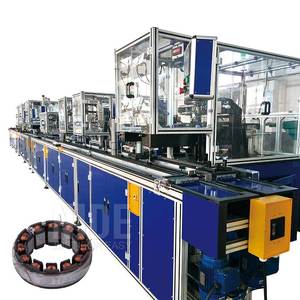
Replacing traditional flyer winding, multi-axis servo-driven needle winders guide wire directly into stator slots. This maximizes copper fill factors (up to 78%), minimizes enamel wire friction, and allows precise multi-layer neat winding for inner-rotor BLDC motors used in automotive pumps and power tools.
2. Closed-Loop Tension Control
Next-generation motor lines incorporate magnetic or electronic digital tensioners. Real-time feedback loops dynamically adjust wire pay-off force during high-speed directional changes, eliminating wire stretching, insulation breakdown, and micro-short circuits.
3. Multi-Model Rapid Tooling Changeover
To cater to flexible batch production (e.g., civilian drone BLDC stators varying from 2207 to 3110 frame sizes), modern lines feature quick-release modular fixtures, quick-change wire nozzles, and digitized recipe storage in HMI touchscreens, reducing tooling setup times to under 15 minutes.
4. Inline Vision & EOL Electrical Diagnostics
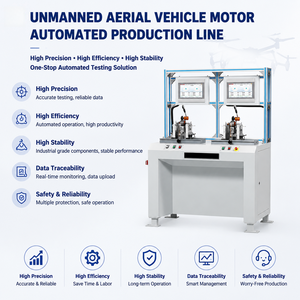
Integrated CCD industrial cameras instantly verify wire pinouts, spot-weld integrity on commutators, and stator paper insertion. EOL testing units concurrently perform insulation resistance, surge testing, AC withstand voltage (hi-pot), and inductance checking before assembly clearance.
5. Industrial IoT & MES Connectivity
Smart assembly lines support OPC-UA and Ethernet/IP protocols. Plant managers gain full traceability down to individual motor serial numbers, monitoring cycle times, scrap counts, temperature profiles during trickling, and predictive maintenance metrics on servo drives.
Procurement Sizing Matrix: Matching Line Architecture to Application
Selecting the optimal motor production configuration requires matching component geometries, wire specifications, and target output volume (UPH). Below is a comparative engineering reference matrix to assist procurement teams during technical scoping:
| Motor Technology |
Recommended Line Architecture |
Key Processing Operations |
Target Applications |
Scrap Rate Target |
| Inner-Rotor BLDC |
Multi-Station Needle Winding Line |
Paper insertion, needle winding, lead wire stripping, terminal soldering, EOL testing |
Power Tools, Automotive Water/Oil Pumps, HVAC Blowers |
< 0.3% |
| Outer-Rotor BLDC |
CNC Outer Stator Winding Conveyor |
Insulating coat check, outer teeth flyer/needle winding, PCB soldering, magnet placement |
Civilian UAVs, FPV Drones, Treadmills, Ceiling Fans |
< 0.2% |
| Brushed DC / Universal |
Rotor Winding & Hot Staking Line |
Armature slot papering, flyer winding, CNC commutator hot staking, trickle varnishing |
Home Appliances, Vacuum Cleaners, Automotive Starters |
< 0.5% |
| Heavy-Duty Traction Motors |
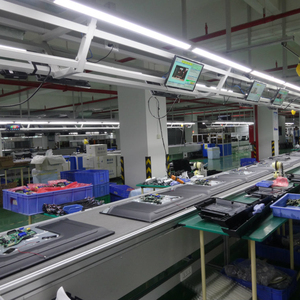
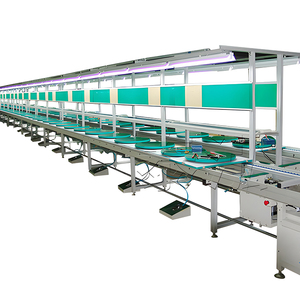
Double-Speed Chain Pallet Conveyor Line |
Stator core press-fitting, heavy wire coil insertion, manual/semi-auto casing assembly |
Electric Forklifts, AGVs, Logistics Vehicles, E-Tricycles |
< 0.1% |
Future Sourcing & Procurement Trends (2025 and Beyond)
Global buyer behavior in electric motor line procurement is shifting rapidly from off-the-shelf catalog machinery purchasing toward co-engineered strategic partnerships. Sourcing directors should prioritize suppliers capable of delivering:
- Sample-Based Custom Engineering: Rather than forcing motor design around standardized machine specs, top-tier Chinese manufacturers utilize customer-supplied physical stators or 3D CAD step files to custom-build CNC winding nozzles, clamping fixtures, and wire guide tooling prior to line assembly.
- Turnkey Lifecycle Integration: Modern RFQs demand complete, end-to-end accountability from a single system integrator. Sourcing a combined line—encompassing raw stamping laminations, automatic winding, resin encapsulation, magnet loading, and EOL test benches—mitigates vendor interface friction and project delay risks.
- Remote Virtual Acceptance & On-Site Global Support: Overseas buyers increasingly rely on high-definition video acceptance protocols (FAT) backed by real-time run-rate validation prior to export shipment. Furthermore, international field engineering support for machine setup, operator training, and process tuning has become a standard requirement.
Proven OEM & ODM Manufacturing Strength
Why Ningbo Davri Automation Equipment Co., Ltd. (Cefnak) Leads the Industry
Based in Ningbo, Zhejiang—a hub for China's electrical machinery and precision automation manufacturing clusters—Ningbo Davri Automation Equipment Co., Ltd. (Cefnak) stands out as a verified leader in motor production technology. Serving global OEMs across North America, Europe, Southeast Asia, and the Middle East, Cefnak bridges the gap between machinery engineering and motor manufacturing expertise.
Unlike standard equipment resellers, Cefnak manages both the equipment engineering side and the motor component production side. This dual focus ensures that machine tooling design, wire tension parameters, and slot filling logic are directly informed by hands-on manufacturing experience.
Intertek On-Site Verified Facility
Our workshop premises, legal standing, R&D labs, and export credentials are independently audited and verified on-site by Intertek, assuring international buyers of transparent operations.
Senior R&D & Tooling Engineering Team
Our engineering team comprises senior automation designers (each possessing 5+ years of dedicated motor tooling experience) utilizing SolidWorks 3D modeling for precise nozzle path simulation.
6 Specialized QC Lab Instruments
Quality control is backed by handheld digital tension meters, hi-pot pressure resistance testers, multi-channel temperature rise devices, and video microscope solder inspectors.
Global On-Site Field Commissioning
We provide full installation, operator instruction, and process tuning directly at customer factories worldwide, backed by remote technical support for line expansion.
Buyer Guidance & FAQ
Frequently Asked Questions for Motor Line Procurement
Comprehensive technical solutions for plant managers, sourcing engineers, and operational buyers.
1. What motor types can your stator winding and assembly lines handle?
Our customized machinery covers a full spectrum of electric motor configurations:
- Needle Winding Lines: Designed for inner-rotor BLDC stators, automotive fuel/water pumps, power tool motors, and compressor stators.
- Outer Stator Winders: Purpose-built for external-rotor motors used in civilian UAVs, commercial FPV drones, treadmill motors, and HVAC blowers.
- Armature & Rotor Winders: Tailored for brushed DC motors, universal motors in home appliances, and high-torque starter motors.
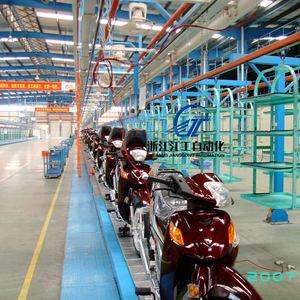
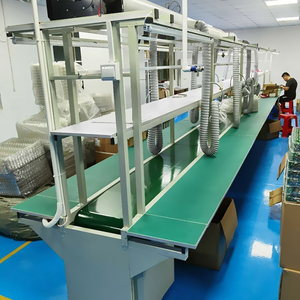
- Heavy Conveyor Lines: Double-speed chain and belt pallet systems engineered for industrial PMSM traction motors, electric forklift drives, and e-vehicle transmissions.
2. What technical parameters are required to generate an accurate RFQ proposal?
To deliver a precise technical proposal and cycle time simulation on the first iteration, our engineering team requires four primary datasets:
- Stator/Rotor Drawing or Physical Sample: Outer diameter, inner diameter, stack height (lamination depth), and slot dimensions.
- Winding Parameters: Wire diameter (AWG/mm), number of turns per coil, phase connection diagram (Star/Delta), and slot fill percentage.
- Target Output: Desired units per hour (UPH), takt time targets, and shift operations schedules.
- Process Scope: Required degree of automation (manual loading, semi-automated cell, or fully integrated turnkey line with auto-packaging).
3. Can machine tooling be customized directly from our physical motor sample?
Yes. Sample-based customization is one of our core strengths. Buyers frequently send prototype stators or 3D STEP drawings to our Ningbo engineering center. We perform 3D SolidWorks tooling modeling, manufacture custom wire nozzles and clamping fixtures, run trial winding tests, and provide video proof of process feasibility before full-scale line fabrication.
4. How do you prevent enamel wire stripping or tension damage during high-speed winding?
We employ closed-loop magnetic or electronic tension control systems coupled with polished ceramic or ruby wire nozzles. Tension levels are digitally monitored in real-time. If tension fluctuates outside set tolerances, the CNC controller automatically adjusts pay-off speed, protecting enamel wire insulation and preventing micro-breakdowns during operation.
5. What is the typical lead time from contract signing to factory shipment?
Standard standalone winding machines (such as 2-station outer winders or 4-station needle winders) typically ship within 30 to 45 calendar days. Complex, fully automated turnkey lines (integrating papering, winding, soldering, assembly, and EOL testing) require 60 to 90 calendar days, inclusive of rigorous internal trial runs and FAT testing.
6. What factory acceptance testing (FAT) procedures are performed before export?
Every assembly line undergoes a 72-hour continuous trial run in our facility using customer-specified wire and stators. FAT protocols check:
- Takt time compliance and UPH verification.
- Winding neatness, stack height clearance, and coil resistance symmetry.
- 100% EOL electrical checks (Hi-pot, surge, and insulation resistance).
- Safety interlock and emergency stop responsiveness.
7. How is after-sales installation and operator training handled for international buyers?
We offer two support pathways:
- On-Site Commissioning: Certified field engineers deploy to your factory to manage installation, wire line wiring, line integration, and operator training.
- Remote Virtual Commissioning: Detailed video documentation, schematics, and live video support enable local technicians to commission modular lines efficiently.
8. How flexible are your lines for handling multiple motor frame sizes (SKUs)?
Our assembly systems feature modular quick-change tooling. By swapping out indexed positioning trays, winding nozzles, and calling up stored job recipes on the HMI touchscreen, operators can transition between different stator stack heights or wire gauges in 15 to 30 minutes, minimizing line downtime.
9. What export packing standards are implemented to ensure safe sea freight?
All machines are treated with anti-rust oil, vacuum sealed in moisture-barrier foil packaging, and anchored inside heavy-duty, fumigation-free wooden cases (IPPC stamped). Sensitive CNC controls and optical sensors are isolated with anti-vibration shock mounts to ensure safe transit.
10. What is the minimum order quantity (MOQ) for machines and custom motor components?
Our MOQs are structured to support both prototype development and full-scale volume manufacturing:
- Winding Machines & Turnkey Lines: MOQ starts at 1 complete set.
- Custom UAV/Drone Motor Stators: MOQ starts at 500 pieces.
- Industrial BLDC / PMSM Traction Motors: MOQ starts at 10 pieces.