Featured Motor Production Lines & Specialized Assemblies
Engineered around your exact stator design, slot configuration, and throughput requirements. Fully compliant with international electrical and mechanical manufacturing specifications.
1. The Shift to High-Voltage EV Compressor Motors in Rio de Janeiro's E-Mobility Ecosystem
The global transition to Electric Vehicles (EVs) has radically altered HVAC (Heating, Ventilation, and Air Conditioning) engineering. In traditional internal combustion engine (ICE) vehicles, air conditioning compressors are mechanically driven via engine accessory belts. Conversely, in modern battery electric vehicles (BEVs), hybrid electric vehicles (HEVs), and fuel cell commercial buses operating across the State of Rio de Janeiro, HVAC systems rely entirely on independent, high-voltage hermetic electric scroll compressors (HV-ESC) driven by embedded Brushless Direct Current (BLDC) or Permanent Magnet Synchronous Motors (PMSM).
As Brazil accelerates its transition toward sustainable transport—driven by national initiatives such as the MOVER Program (Mobility Access and Innovation Program, succeeding Rota 2030) and Rio de Janeiro’s municipal decarbonization targets for public transit (BRT Rio)—automotive Tier-1 suppliers, electric bus assemblers, and aftermarket component manufacturers in the Sul Fluminense Industrial Corridor (Resende, Porto Real, and Itatiaia hub) are facing urgent demand for local assembly capabilities. Importing fully assembled EV compressor motors incurs prohibitive tariffs under Brazil’s SISCOMEX regime, elevated freight costs, and supply chain vulnerabilities. Establishing automated, locally adapted EV compressor motor production lines in Rio de Janeiro has become a strategic imperative.
Core Engineering Challenge: EV Compressor Motors in coastal Latin American climates must maintain absolute insulation integrity under high-voltage operating windows (300V–800V DC), endure extreme ambient humidity, and deliver near-silent Acoustic Noise and Vibration (NVH) performance within compact, hermetic aluminum housings.
1.1 Key Engineering Requirements for EV Compressor Motors
Unlike standard industrial motors, EV compressor motors operate directly inside hermetic refrigerant environments (often mixed with polyolester POE synthetic oils). Consequently, production equipment must adhere to rigorous quality metrics:
Slot Fill Factor > 68%
Maximizing copper density in compact stators using high-speed needle winding or segmented tooth winding architectures to optimize COP (Coefficient of Performance).
Dielectric Insulation
Zero-defect insulation paper insertion and high-pot withstand voltage insulation up to 3,000V AC to prevent partial discharge under fast-charging voltage spikes.
Hermetic Varnish Coating
Automated trickle or Vacuum Pressure Impregnation (VPI) using refrigerant-resistant resin to prevent chemical breakdown caused by R134a/R1234yf liquids.
2. Turnkey Automated EV Compressor Motor Production Line Architecture
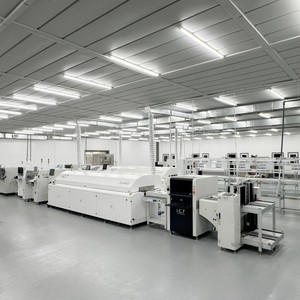
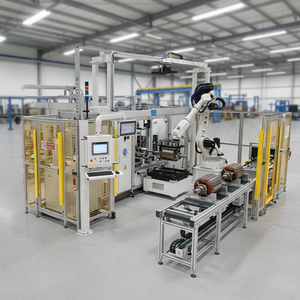
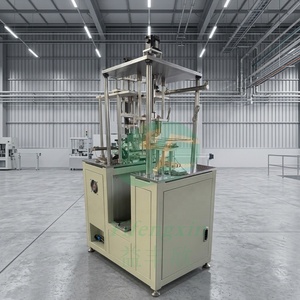
Ningbo Davri Automation Equipment Co., Ltd. (Cefnak) designs and integrates full-process automated production lines configured specifically for high-efficiency electric compressor motors. Our lines integrate every step from raw lamination handling to final End-of-Line (EOL) testing, operating at high tactical speed (Takt Times as low as 45 seconds per stator assembly).
| Production Module | Core Process Technology | Automation & Control Specs | Quality Checkpoints |
|---|---|---|---|
| Module 1: Stator Core Preparation | Automatic slot paper insertion & end-insulation insulator pressing. | Servo-driven indexing, PLC-controlled paper feeding (B-class / H-class DMD). | 100% Optical vision check for paper positioning and slot overhang. |
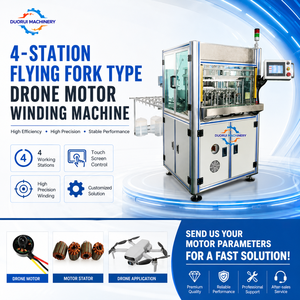
| Module 2: Precision Winding | 4-Station High-Speed CNC Needle Type Internal Stator Winding. | Multi-axis CNC continuous path control, dynamic wire tension management. | Handheld & inline digital tension logging; enamel wire scratch monitoring. |
| Module 3: Wire Termination & Welding | CNC wire stripping, phase lead shaping, TIG/Laser spot welding & hot staking. | Closed-loop thermal monitoring; automated crimping and fluxless joining. | Micro-ohmmeter contact resistance check; 100% weld bead visual inspection. |
| Module 4: Resin Impregnation | Automatic trickle varnishing & induction gel curing tunnel. | Precision peristaltic pump delivery; multi-zone temperature profile control. | Weight-gain validation; zero-drip resin clean surface check. |
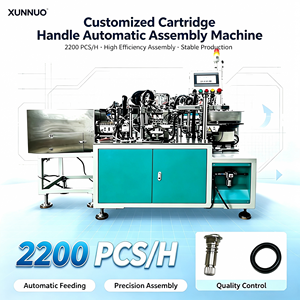
| Module 5: Rotor Magnet Assembly | IPM/SPM Rare-earth magnet insertion, gluing, dynamic balancing & sleeving. | Robotic pick-and-place; dual-plane automatic dynamic balancing drill station. | Residual unbalance < 0.5 g·mm/kg; high-speed magnetic field profiling. |
| Module 6: Final Assembly & EOL | Hermetic housing pressing, bearing pressing, terminal connection & testing. | Servo-press with load-versus-displacement curve recording; automated tester. | Hi-Pot (3000V), Insulation Resistance (>500MΩ), Back-EMF, NVH noise spectrum. |
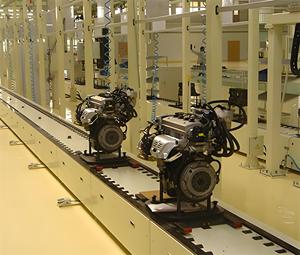
By automating the inter-station material handling via modular palletized conveyor systems, our production lines minimize human contact, eliminating airborne particulate contamination—a critical factor for maintaining hermetic compressor reliability.
3. Localized Industrial Application Scenarios in Rio de Janeiro & Brazil
Deploying automated motor manufacturing equipment in Rio de Janeiro requires an intimate understanding of the local industrial ecosystem, climate conditions, and municipal transport infrastructure.
3.1 Electrification of Public Transit: BRT Rio & Municipal E-Buses
Rio de Janeiro’s rapid transit system (BRT Bus Rapid Transit) is executing an aggressive replacement of diesel articulated buses with 100% electric heavy buses. Bus EV air conditioning units demand high-cooling capacity electric compressors (typically requiring 12kW to 24kW cooling output powered by 550V–750V DC traction batteries). Cefnak’s specialized Bus & Heavy Vehicle EV Compressor Stator Winding Lines accommodate large-diameter stators, thick wire gauges, and multi-strand parallel winding to withstand the heavy continuous duty cycles of Rio's tropical urban traffic.
3.2 The Fluminense Automotive Hub (Resende & Porto Real Corridor)
Located along the President Dutra Highway connecting Rio de Janeiro to São Paulo, the Fluminense Automotive Valley hosts global automotive OEMs, commercial vehicle plants, and Tier-1 HVAC component vendors. Manufacturing equipment delivered to this region must integrate seamless MES (Manufacturing Execution System) traceability, barcode tracking, and PROFIBUS/PROFINET industrial communications protocols to mesh directly into Industry 4.0 plant architectures.
3.3 Tropicalization: Salt Mist & Humidity Engineering
Rio de Janeiro’s coastal geography exposes manufacturing facilities and vehicle components to high relative humidity (frequently exceeding 85%) and coastal marine salt spray. Cefnak engineers incorporate specific "Tropicalization" safeguards into all exported production lines:
- Electrical Enclosures: IP65-rated stainless steel control cabinets equipped with integrated internal dehumidifiers and air-conditioned panel coolers.
- Structural Frames: Electroplated structural steel with anti-corrosion marine grade coatings to prevent frame degradation.
- Pneumatics & Hydraulics: Fluororubber seals and anodized aluminum pneumatic cylinders resistant to ambient moisture accumulation.
4. Brazil Regulatory Landscape: Navigating NR-12, SISCOMEX & EX-Tarifário
Exporting industrial automation equipment to Rio de Janeiro involves navigating stringent Brazilian regulatory standards and tariff structures. A successful deployment depends as much on regulatory compliance as on mechanical engineering.
4.1 NR-12 Machinery Safety Compliance
Brazil’s Norma Regulamentadora 12 (NR-12) enforces strict safety mandates for machinery operators. Equipment imported into Rio de Janeiro that fails to meet NR-12 standards faces immediate operation halts by auditors from the Ministry of Labor (MTE). Cefnak custom-engineers exported production lines to comply fully with NR-12:
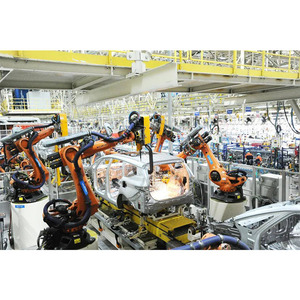
• Category 4 / PLe dual-channel safety relays and light curtains surrounding all robotic loading and winding zones.
• Safety-interlocked physical enclosure doors with mandatory key containment systems.
• Fully localized Portuguese-language HMI control screens, safety labeling, and technical documentation.
• Dedicated NR-12 electrical schematics incorporating emergency stop circuits and manual reset blocks.
4.2 Tariff Optimization via EX-Tarifário (NCM 8479.89)
Capital expenditure (CapEx) for establishing a new production line in Rio de Janeiro can be significantly reduced by applying for Brazil’s EX-Tarifário regime under NCM code 8479.89.99 (Industrial Machinery and Equipment). When a specific automated line configuration has no direct national equivalent manufactured inside Brazil, the EX-Tarifário mechanism reduces the import duty (Imposto de Importação - II) from up to 14% down to 0%–2%. Cefnak provides complete technical dossiers, 3D exploded layout drawings, and functional descriptions to assist Brazilian importers during their Ministry of Development, Industry, Trade and Services (MDIC) submission process.
5. Why Leading Global Motor Manufacturers Partner with Cefnak (Ningbo Davri)
Ningbo Davri Automation Equipment Co., Ltd. (Cefnak) operates at the convergence of machine tool manufacturing and high-precision motor engineering. Located in Ningbo, Zhejiang—a global hub for permanent magnet materials and electric motor supply chains—we bring verifiable manufacturing authority to international buyers.
Intertek Verified Facility
Our workshop premises, engineering credentials, and manufacturing operations undergo rigorous on-site audit and verification by Intertek.
Sample-Based Customization
We do not sell rigid off-the-shelf catalog units. Send your motor stator sample or 3D drawing, and our 5+ senior engineers build custom tooling, winding paths, and trial validation.
In-House QC & Testing Lab
Equipped with 6 specialized laboratory instruments: Digital wire tension meters, Hi-Pot withstand testers, multi-channel temperature rise loggers, and video microscopes.
5.1 End-to-End Overseas Service Protocol for Rio de Janeiro
To ensure seamless installation for clients in South America, Cefnak provides an overseas engineering dispatch protocol:
1. Virtual Factory Acceptance Test (FAT): Real-time high-definition video commissioning running your actual copper wire and stator laminations in our Ningbo facility prior to export packing.
2. Turnkey Export Packing: Vacuum-sealed moisture-proof aluminum foil packaging combined with fumigated solid wooden crates engineered for long-distance maritime transport to the Port of Rio de Janeiro or Port of Santos.
3. On-Site Engineer Deployment: Our senior automation engineers travel directly to your facility in Rio de Janeiro to manage mechanical assembly, electrical wiring to local 220V/380V 60Hz power grids, operator training, and initial mass-production ramping.
6. Frequently Asked Questions (FAQ) — Local Procurement & Engineering
Addressing the top technical, regulatory, and commercial inquiries from procurement directors and plant managers in Rio de Janeiro and Latin America.
Q1: How does Cefnak guarantee that production line electrical panels suit Brazil's 60Hz power grid?
All electrical panels built for export to Rio de Janeiro are custom-engineered for Brazil's dual-frequency and multi-voltage industrial infrastructure (typically 220V, 380V, or 440V three-phase at 60 Hz). We integrate premium global electrical components (such as Schneider, Siemens, and Omron) certified for 60Hz operational stability, equipped with internal voltage stabilization and surge protection modules.
Q2: What is the average lead time for a complete EV Compressor Motor Stator Production Line?
Standard manufacturing lead time ranges between 60 to 90 days following final CAD drawing approval and sample receipt. Sea freight from Ningbo Port to the Port of Rio de Janeiro typically takes 30 to 38 transit days. We provide comprehensive milestone tracking and weekly production video updates throughout the build process.
Q3: Can your winding machines handle both inner-rotor and outer-rotor EV compressor motor designs?
Yes. We manufacture dual distinct series: Needle Type Internal Stator Winding Machines for inner-rotor BLDC/PMSM designs (commonly used in automotive electric scroll compressors), and Outer Stator Winding Machines for external-rotor configurations. Our modular winding heads allow rapid tooling changeovers between different stack heights and slot numbers.
Q4: What technical support and spare parts availability do you provide after deployment in Rio de Janeiro?
We supply a mandatory 2-year operational spare parts package (including spare winding needles, wire guides, cutter blades, and pneumatic wear items) alongside every machine shipment. Furthermore, our control systems feature remote Ethernet gateway connectivity, allowing Cefnak software engineers to diagnose code, adjust PLC parameters, and troubleshoot HMI issues in real time from our headquarters.
Q5: Do you provide full NR-12 safety certification documentation required by Brazilian labor auditors?
Yes. When specified during the initial proposal phase, our engineering team designs the machinery in strict compliance with NR-12 standards. We issue complete technical documentation, including safety category circuit diagrams, risk assessment matrices, and bilingual operation manuals in Portuguese and English.
Q6: How do we initiate a custom technical proposal for our motor project?
Simply provide your motor stator slot count, stack height, wire gauge diameter, target turns per coil, voltage rating, and desired hourly production volume (UPH). Sending physical stator samples or CAD lamination files enables our engineering team to generate a complete 3D line concept and commercial proposal within 48 hours.
Ready to Modernize Your EV Compressor Motor Production in Rio de Janeiro?
Speak directly with our senior motor automation engineers. We will analyze your stator specifications, review your throughput targets, and construct a tailored turnkey proposal.
Send an Inquiry